

Steady corporate governance is the cornerstone of the sustainable operation. The Company conducts corporate governance with an honest attitude, establishes a sound mechanism, and draws a blueprint for sustainable governance.
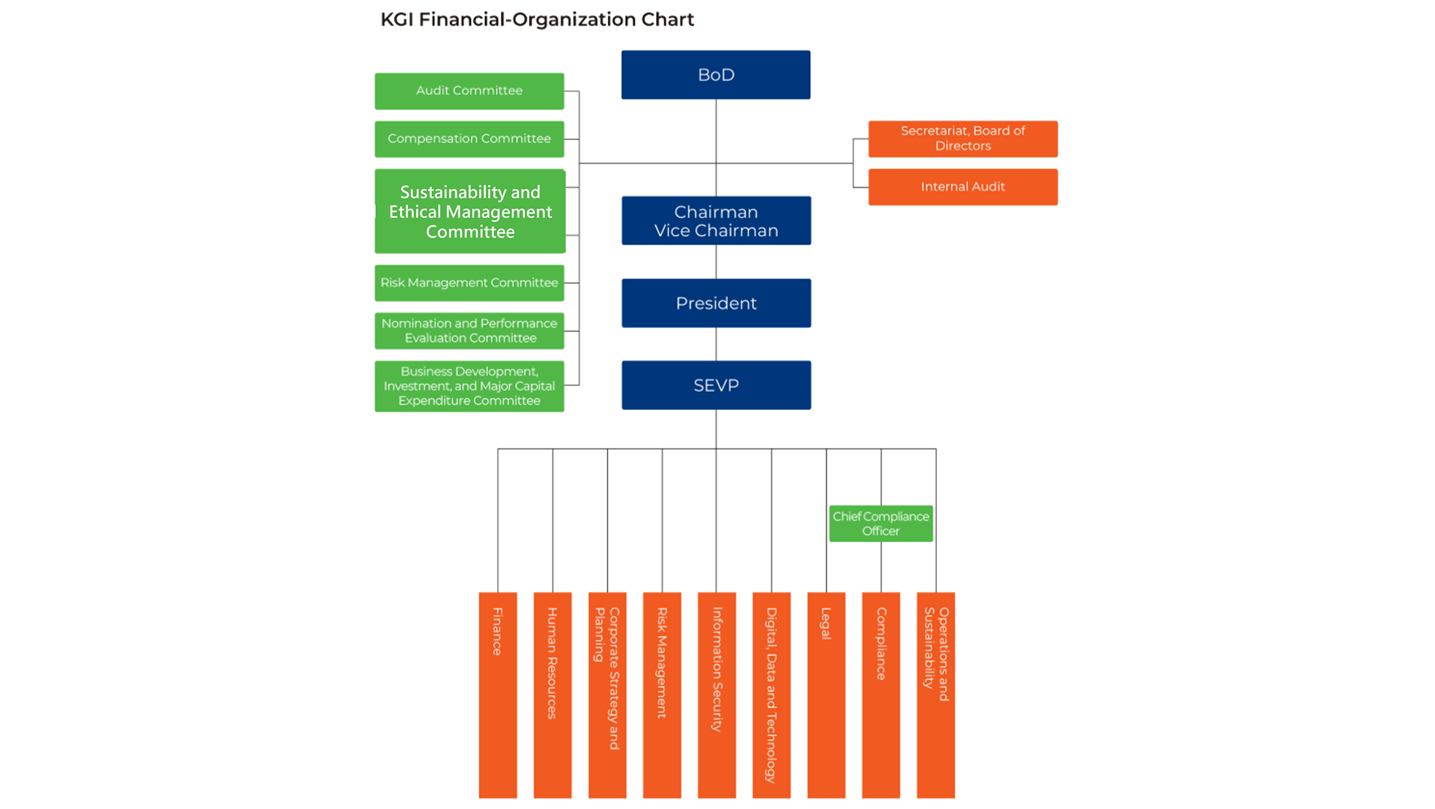
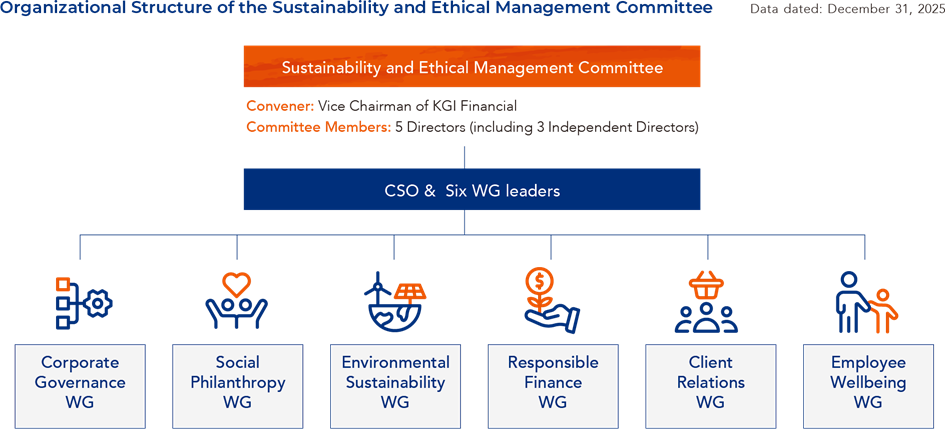
The Company’s Board of Directors serves as the highest governance and supervisory body for sustainable development. With the goal of “actively participating in public affairs and promoting a balance among economic, social, and environmental ecosystems to fulfill corporate social responsibility,” the Company has established a Board-level Sustainability and Ethical Management Committee. The Committee is composed of Company directors, including three independent directors, and oversees six working groups focused on corporate governance, social philanthropy, environmental sustainability, responsible finance, client relations, and employee wellbeing. Senior management under the General Manager serve as working group leaders, with the Chief Sustainability Officer leading the working group leaders in proposing and executing annual concrete action plans on ESG issues.
When formulating ESG-related plans, each working group incorporates feedback from internal and external stakeholders and bases the annual implementation plans on the results of materiality assessments. At the same time, the Company’s corporate shareholders, through their board representatives, communicate and discuss their concerns regarding economic, environmental, and social (ESG) issues with the Company via the Board of Directors or the Sustainability and Ethical Management Committee. The Sustainability and Ethical Management Committee submits an annual report to the Board of Directors on the work plans and their implementation status of each working group.
To ensure proper management of the Company’s sustainability information and enhance disclosure quality, the Company newly established the “Sustainability Information Management Guidelines” in 2024. The Sustainability Report is prepared in accordance with regulations, with the Operations and Sustainability Development Department responsible for collecting and consolidating data from all sustainability information units. After confirmation by the leaders of each working group and verification by a third-party certification body, the report is submitted for approval to the Sustainability and Ethical Management Committee and the Board of Directors.
In 2025, the Sustainability and Ethical Management Committee convened six times. In accordance with the Company’s “Sustainability and Ethical Management Committee Organizational Charter,” the Committee reviewed or reported on key annual sustainability development matters and submitted them to the Board of Directors, including:
- Report on the implementation status of the Company’s sustainable development work plans for 2024 and the first half of 2025; the progress schedule for the adoption of IFRS Sustainability Disclosure Standards from the first to the third quarter of 2025; the 2025 project execution progress of the Climate and Nature Management Task Force; the implementation status of integrity management in 2024; and the results of major topic identification in 2024.
- Approved the 2026 Sustainable Development Work Plan and the 2024 Sustainability Report.
- Amendments to regulations related to sustainability and integrity management.
- Handling matters relating to board meetings and shareholders meetings according to laws.
- Producing minutes of board meetings and shareholders meetings.
- Assisting in onboarding and continuous development of directors.
- Furnishing information required for business execution by directors.
- Assisting directors with legal compliance.
- Reporting to the Board of Directors the review results of independent directors’ qualifications comply with laws and regulations at the time of nomination, election and during appointment periods.
- Handling matters relating to director changes.
- Other matters set out in the articles of corporation or contracts.

- Internal audit must disclose the following items:
(1)Prepare internal audit working manuals and working papers and whether the internal controls are carried out in a reasonably effective manner, and from time to time provide recommendations for improvement.
(2)The internal audit department shall monitor the rules and procedures for self-inspection and assessments of the internal control system by business and management units, and the implementation of periodic self-inspection by each unit.
(3)Formulate annual audit plans and, based on the business risk profile of and implementation of internal audits by each subsidiary or department, determine audit plans targeted at each individual subsidiary or department.
- The internal audit department shall draft a written audit plan for the coming year at the end of each year to get the audit committee and the board's approval.
- The internal audit department presents an audit plan for the coming year to the supervisory authority via the internet in the prescribed format the end of every year, as will as a review of the previous year's audit operations by the end of February and a report on improvements made to the previous year's internal control issues by the end of May.
- The internal audit department shall conduct a routine business audit at least annually, and a special business audit on KGI Financial's subsidiaries' finance, risk management and legal compliance with applicable acts and regulations at least semiannually. Other audit activities that cover the derivatives business should be conducted on a monthly basis.
- The internal audit report shall delivered to audit committee for review after is reported to the chairman and president & CEO within two months of completion and filed with the competent authority for recordation via an internet-based information system.
- A written report on the continued improvements as required by the supervisory authority, the CPA, the audit office and the compliance department is sent to the board and supervisors and is used as a key reference material for performance appraisal.
- The internal audit department shall supervise KGI Financial's domestic and overseas subsidiaries in accordance with relevant regulations.
- The internal audit department assesses internal audit operations at subsidiaries once a year, submits an assessment report to the board and sends the same report to the boards of KGI Financial subsidiaries as reference materials for performance appraisal.
- The KGI Financial internal audit office oversees the annual self-assessment of internal controls of each department and subsidiary and reviews the subsequent reports. The reports, along with the opinions of the financial examination authority, CPA and internal audit department, are submitted to the chairman, president & CEO, chief audit officer and legal compliance officer of the Headquarters as reference materials for evaluation of the internal control system and the drafting of an internal control compliance declaration.
- The internal audit department shall organize self-inspection programs for every year and continue proper training courses for auditors in accordance with the nature of each department.
- In case of fraud and other major legal infractions, the internal audit department shall inspect all business activities, including appropriate policies and procedures as follow:
(1)Report to the Chairman of the Board and the independent directors and inform the competent authority when significant deficiency or malpractice in compliance matters occurred. All relevant material that has been submitted to the competent authority shall be reported to the audit committee for approval.
(2)Prepare a written report for submission, with a notice to the Chairman of the Board and get the audit committee approval and report to the competent authority, when their recommendations for improvements regarding significant deficiencies or noncompliance identified in internal controls are not accepted by management and as a result KGI Financial or its subsidiaries might incur a material loss.
(3)Request the respective departments where significant deficiency or malpractice occurred to take immediate and adequate countermeasures and shall continually conduct follow-up reviews on matters specified as requiring stronger improvement efforts. The written report on the implementation of improvement of deficiencies shall be submitted to the audit committee and the board of directors for approval.
- In order to improve audit quality and enhance auditing staffs' professional developments, auditing staff are required to take internal or external training courses of at least 30 hours per year to enhance their expertise. Since 2007, KGI Financial internal audit department has organized an annual one-day training event for all auditors, as well as occasional study groups to enhance their expertise. Auditing staff also participate in domestic and international conferences to improve their knowledge of advanced auditing concepts and methods to boost workplace efficiency.
- Other auditing activities
(1)Items requested by the supervisory authority.
(2)Supervision of procurement at KGI Financial and its subsidiaries.
(3)Participation in internal and external symposiums and conferences.
- The KGI Financial internal audit department, which is subordinate to the board of directors, is in charge of general auditing affairs and the organization and scope of internal audits. The department, as a disinterested body, reports to the board and audit committee at least every half year.
- The position of chief audit officer, who supervises all auditing staffs, is on a par with that of VP, and his/her hire, dismissal or transfer shall not come into effect until approved by two thirds of board members and the supervisory authority.

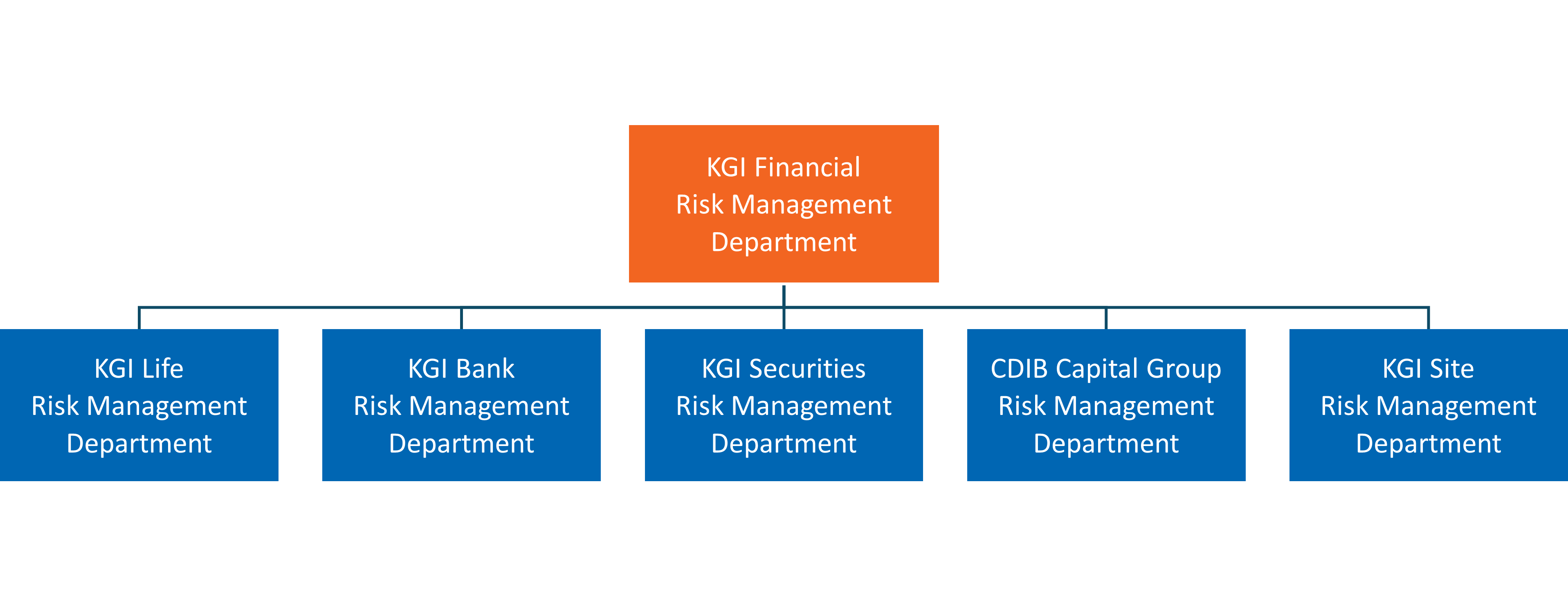
To maintain the independence and appropriateness of the Group's risk exposure management, the Company has established an independent Risk Management Department, which serves as the executive unit of the Risk Management and Information Security Committee. The Department is responsible for developing and implementing the Group's risk management framework, formulating risk management policies and related regulations, overseeing subsidiaries' establishment and compliance with risk management systems, monitoring the appropriateness of risk exposures and the effectiveness of risk control mechanisms, and providing senior management and the Board of Directors with comprehensive risk management information.
The Risk Management Department reports quarterly to the Risk Management and Information Security Committee and the Board of Directors on the overall status of risk management implementation and related improvement recommendations.

• Risk management
• Improving service quality and customer relationship management

• 24-hour service hotline, complaint hotline, and website visitor message board
• Conduct irregular customer satisfaction survey
• Irregular financial management workshops and seminars

• ESG risk and opportunities in investment and financing
• FinTech and digital innovation
• All subsidiaries, CDF Foundation and KGI Charity Foundation serve as the contact channel to communicate with related community groups
・Corporate governance and ethical management
・Risk management
・Regular and irregular announcements and communications related to human resources policies/guidelines/ practices/various employee activities (regular announcements have different frequencies depending on the theme and are communicated via email, internal website, or meetings)
・Quarterly and irregular labor-management meeting/labor union communication
Competent Authorities
• Corporate governance and ethical management
• ESG risk and opportunities in investment and financing
• Irregular visit the competent authority from time to time
• Set up mailbox for government and competent authorities
• Risk management
• Corporate governance and ethical management
• Irregular roadshow to share with investees
• Irregular visits to investees
• Set up investee mailbox
• ESG risk and opportunities in investment and financing
• FinTech and digital innovation
• Irregular press conference
• Set up media service mailbox
• Labor protection and workplace inclusion and equality
• Employment and training for diversity of talents
• Annual shareholders' meeting
• Quarterly domestic institutional investor conference, irregular analyst visits, conference calls, and forums
• Shareholder services and investor relations contact persons
• Corporate governance and ethical management
• FinTech and digital innovation
• Irregular pre-bidding briefing
• We conduct annual supplier evaluations and self-assessments
• We conduct annual on-site audits of key suppliers
• We hold an annual Supplier Conference, which includes ESG education and training for suppliers as well as recognition of outstanding service suppliers
• Establish procurement mailbox and hotline
The Compliance Department of the Company is the handling unit of whistleblowing cases. Reports received through the Company's and independent third-party reporting channels will be forwarded to the handling unit for processing.
The Company will keep the identity of the whistleblower and the content of the report confidential. If the whistleblower is an employee of the Company or a subsidiary, the Company will provide appropriate protective measures and ensure zero tolerance for retaliation, which means that the whistleblower shall not be terminated, dismissed, downgraded/relocated, given a reduction in pay, impairment to any entitlement under the law, contract or customs, or other unfavorable disposition due to the reported case.
Note: Regarding the protection of whistleblower's personal information, please refer to the "Personal Data Notification Statement" and "Privacy Policy" at the bottom of this page.